
MCA Changed Your Director KYC Rules Twice Since December. Here Is What Every Director Must Know Before June 30.
Published on:
Category: Corporate Compliance
Author: CS Nawal Kishore Verma
The Story :
Vikas is a director of a small private limited company in Gurugram. In January 2026, he got a new mobile number — changed his SIM, updated his contacts, informed his bank. Life moved on.
He did not think about his DIN.
In March 2026, his accountant tried to file the company's ADT-1. The MCA portal returned an error. His CA called WeConsult India with three words: DIN is deactivated.
Vikas's new mobile number was not updated in the MCA registry. Under the new rules effective 31 March 2026, any change in mobile number, email address, or residential address must be updated in DIR-3 KYC Web within 30 days. Vikas had missed that window by 6 weeks. Reactivating his DIN: Rs 5,000. Every day it stayed deactivated: Rs 100/day on each blocked form.
Two notifications. Two changes. Most directors know about neither.
The Real Problem — Three Assumptions That Are Now Wrong
Ask any director when their DIR-3 KYC is due: September 30 every year. Ask if there is a fee: It is free. Ask if they need to update after changing their mobile: No, I do not think so.
All three of these assumptions became wrong in the last four months.
Think of your DIN like a driving licence. The car is ready. The road is open. But without an active DIN, no form gets filed — not AOC-4, not MGT-7, not ADT-1, not any form requiring your digital signature.
The danger is not the Rs 5,000 reactivation fee. The danger is the cascade. A deactivated DIN blocks every MCA filing requiring your signature — and every blocked filing triggers its own Rs 100/day penalty with no ceiling.
The Law Explained Simply — Two Notifications, Two Changes
Change 1: G.S.R. 943(E) dated 31 December 2025 — effective 31 March 2026
Annual DIR-3 KYC filing replaced with a triennial (every 3 years) cycle. Deadline moved from 30 September to 30 June. Two earlier forms merged into one unified DIR-3 KYC Web form. Any draft or pending forms as of 31 March 2026 automatically cancelled — fresh filing required.
Change 2: G.S.R. 300(E) dated 21 April 2026 — effective immediately
New fee structure for DIR-3 KYC filings:
|
Situation |
New Fee — G.S.R. 300(E) of 21 April 2026 |
|
Filed on time (within triennial cycle, before 30 June) |
Rs 0 — no fee |
|
Filed late OR to reactivate a deactivated DIN |
Rs 5,000 |
|
Filed mid-cycle due to change in mobile, email, or address |
Rs 500 per filing |
|
Change in personal details must be filed within |
30 days of the change |
|
Regulatory Event |
What It Means for Your Business |
|
Triennial cycle — G.S.R. 943(E) effective 31 March 2026 |
If you filed DIR-3 KYC for FY 2025-26, next routine filing is June 30, 2028 — but any detail change triggers a fresh Rs 500 filing within 30 days |
|
New fee structure — G.S.R. 300(E) effective 21 April 2026 |
Rs 5,000 for late or reactivation. Rs 500 for each mid-cycle detail update. Rs 0 only if filed on time in your triennial year |
|
DIN deactivation |
Director cannot sign any MCA form — ALL company filings requiring that signature are blocked immediately |
|
Blocked filings cascade |
AOC-4: Rs 100/day. MGT-7: Rs 100/day. ADT-1, DPT-3, event-based forms: blocked. Two forms = Rs 200/day accumulating with no ceiling |
Vikas vs Deepa — The Same Mobile Number Change, Two Very Different Outcomes
Deepa's CS sent her a WhatsApp the day the notification was published. She had changed her mobile in January. She filed DIR-3 KYC Web before the new rules were even notified — free, under the old regime. DIN stayed active. All company filings stayed unblocked.
Vikas's CA was not tracking the notifications. Nobody told Vikas. By April, when his company's ADT-1 was due, the portal flagged the mismatch. DIN deactivated. Reactivation fee: Rs 5,000. Pending ADT-1 and AOC-4 accumulating Rs 200 per day.
Total cost of Vikas's missed Rs 500 filing: Rs 5,000 for DIN reactivation + professional fees + 12 days of blocked filing penalties = over Rs 8,000 before the company was compliant again.
The difference is not which CS they called. It is when the CS told them.
How to Actually Start — 5 Steps Every Director Must Take This Week
1. Step 1 — Check your DIN status on MCA right now — Log into mca.gov.in — MCA Services — DIN Services — Verify DIN/DPIN. If it shows Deactivated due to non-filing of DIR-3 KYC, your company's filings requiring your signature are already blocked. If it shows Approved, proceed to Step 2.
2. Step 2 — Identify which DIR-3 KYC cycle you fall into — DIN allotted on or before 31 March 2023: file by 30 June 2026 (Rs 0 fee). DIN allotted FY 2023-24 or 2024-25: next filing April-June 2027 or 2028. DIN allotted FY 2025-26: first filing April-June 2029. Mark the correct deadline in your calendar today.
3. Step 3 — Check every personal detail that may have changed since your last filing — Mobile number, email address, residential address — compare what MCA shows versus what you actually use today. If any has changed, a Rs 500 DIR-3 KYC Web filing is required within 30 days. If the 30-day window has passed, consult a CS on the correct fee category — it may attract the Rs 5,000 late fee instead.
4. Step 4 — File DIR-3 KYC Web — not the old e-Form — Both earlier forms are replaced by the unified DIR-3 KYC Web form under substituted Rule 12A. Old e-Forms in draft before 31 March 2026 were automatically cancelled by MCA. Do not attempt to submit them. File a fresh DIR-3 KYC Web form only.
5. Step 5 — Build a 30-day contact-change protocol into your compliance systems — Every time any director changes their mobile, email, or address, a Rs 500 DIR-3 KYC Web filing is triggered within 30 days. In a company with four directors, budget this alongside your auditor appointment, AGM, and annual return deadlines.
A deactivated DIN is not just a compliance problem. It is a filing emergency. Every day costs money.
Key Takeaways
|
Key Compliance Point |
What You Must Do |
|
DIR-3 KYC is now triennial. Deadline is June 30, not September 30. |
Check your DIN cycle year. If DIN allotted on or before March 2023, file by June 30, 2026 — or pay Rs 5,000 |
|
Changed mobile, email, or address? File within 30 days — Rs 500 fee |
Review all three details against your MCA registry record today. If 30-day window has passed, consult CS on correct fee category |
|
DIN deactivation blocks ALL MCA filings requiring your signature |
If DIN already deactivated, reactivation costs Rs 5,000 + Rs 100/day on each blocked form accumulating |
|
Draft/pending DIR-3 KYC e-Forms before 31 March 2026 were auto-cancelled |
File a fresh unified DIR-3 KYC Web form only. Do not attempt to submit old forms. |
But Here Is the Other Side...
One Last Thing — The DIN Is Small. The Cascade Is Not.
The DIR-3 KYC Web form takes 15 minutes to file online. The OTP is sent to your registered mobile. There is no office visit, no DSC required for the Web form. The fee is Rs 0 if you file on time.
The Rs 5,000 penalty does not feel large until you realise that a deactivated DIN costs you that plus every day of blocked filings at Rs 100 per form per day — plus a CS's emergency fee to reactivate it. Vikas's total cost was over Rs 8,000. His filing took 15 minutes once the DIN was reactivated.
WeConsult India manages DIR-3 KYC compliance for directors across Gurugram's Sector 90, MG Road, and the Udyog Vihar corridor. Contact us to verify your cycle year and file before the June 30 deadline.
Stay compliant. Stay protected. — WeConsult India
This blog is for informational purposes only and does not constitute legal or professional advice. Please consult a qualified Company Secretary or Chartered Accountant before acting on any compliance matter.
Related Blogs
More articles from the corporate compliance.

Corporate Compliance
private limited company vs LLP India 2026
Private Limited Company vs LLP: The 3 Questions That Tell You Which One Your Business Actually Needs CS Nawal Kishor Verma | WeConsult India | 27 April 2026 Karan spent six weeks researching before he incorporated. He read four government portals, asked two CAs, watched three YouTube videos, and got four different answers. By the time he incorporated — LLP, finally — he had chosen based on exhaustion, not clarity. Eighteen months later, an angel investor wanted to write a cheque for ₹50 lakh into Karan's business. The term sheet landed on a Tuesday. By Thursday, his CS had explained that LLPs cannot issue equity shares. The investor could not participate. Karan would need to convert to a Private Limited Company — a process that took four months and cost ₹85,000 — before the deal could proceed. The confusion between a Private Limited Company and an LLP is not about names or registration fees. It is about one decision made on day one that determines everything that follows — funding, taxation, compliance cost, credibility, and exit. The Real Problem — Why Most Founders Choose Wrong Both structures share several important features. They both provide limited liability. Both are registered with MCA. Both have a separate legal identity. Neither requires a minimum paid-up capital. This is where most comparison articles stop — and where most founders get confused. The differences that actually matter are not on the registration form. They appear 18 months later, when a bank asks for audited financials, or when an investor wants equity, or when you realise your annual compliance bill is five times what you budgeted. Think of it this way: choosing between a Pvt Ltd and an LLP is like choosing between a salary account and a current account. Both hold money, both work for daily transactions — but only one has the institutional architecture a bank or investor is looking for when it counts. The wrong choice does not close your business. It just creates a problem you cannot solve from the inside. The Law Explained Simply — What Each Structure Is Private Limited Company: Governed by the Companies Act, 2013. Shareholders (owners) and directors (managers) are legally distinct roles — up to 200 shareholders. Can issue equity shares. Mandatory statutory audit from Year 1. LLP: Governed by the LLP Act, 2008. Designated partners who are both owners and managers — no upper limit on partners. Cannot issue equity shares. Audit mandatory only if annual turnover exceeds ₹40 lakh OR capital contribution exceeds ₹25 lakh. Decision Factor Private Limited Company LLP Raise equity from VC / angel ✅ Yes — via equity shares ❌ No — no share structure exists FDI under automatic route ✅ Yes — most sectors ⚠️ Govt approval required Mandatory audit ✅ From Year 1, any turnover Only if turnover > ₹40L or capital > ₹25L Annual compliance cost ₹40,000–₹70,000/year ₹8,000–₹15,000 (no audit) Corporate tax rate 25% (turnover up to ₹400 cr) / 22% new regime Flat 30% + surcharge Profit distribution Dividend taxed in shareholders' hands Partner share exempt under Sec 10(2A) MCA late fee ₹100/day per form — no ceiling ₹100/day per form — no ceiling Karan vs Priya — The Same Business, Two Very Different Outcomes Both Karan and Priya launched software consulting firms in 2023. Same city, same first-year turnover (₹18 lakh), same team of three people. Karan formed an LLP. His Year 1 compliance cost: ₹11,000. He was winning. Priya formed a Private Limited Company. Her Year 1 compliance cost: ₹52,000 — including statutory audit, ROC filings, board meeting minutes, and CS fees. In Year 2, Priya met an angel investor who offered ₹60 lakh for 20% equity. The deal closed in 11 weeks. She used the capital to hire four senior developers and land a ₹1.2 crore enterprise contract. The same investor met Karan three months later. The term sheet was ready. Then his CS explained that an LLP cannot issue equity shares. The investor could not participate. Karan spent four months and ₹85,000 converting to a Private Limited Company. By the time it was done, the investor had deployed his capital elsewhere. The difference was not Karan's product or his talent. It was a structural decision made before the business had a single rupee of revenue. The 3 Questions That Tell You Which Structure to Form Question 1: Do you ever plan to raise money from an outside investor? If yes — now, in two years, or even 'maybe someday' — form a Private Limited Company on day one. Converting later is expensive, slow, and happens at the worst possible time. If definitively no — you are self-funded and always will be — an LLP is a legitimate option. Question 2: Is your annual turnover likely to cross ₹40 lakh in the next 24 months? If yes, your LLP will require a statutory audit anyway. The compliance gap narrows significantly. At that point, the Pvt Ltd gives you investor-readiness, better bank credibility, and a lower tax rate — at only marginally higher cost. Question 3: Are you in a regulated professional services sector? If yes — CA practice, law firm, architecture studio, consulting partnership — an LLP has significant cultural and legal precedent. The partner-managed structure maps naturally, and single-layer taxation on profit distributions is more efficient for firms that distribute most of what they earn. How to Actually Start — 5 Steps to Making This Decision Correctly 1. Step 1 — Answer the 3 questions first — Answer the three questions above before opening any government portal. Write your answers down. The three questions are the only decision framework that matters. 2. Step 2 — Check FDI rules if relevant — If you have any foreign co-founders, foreign investors, or international clients who might want equity stakes — check FDI rules for your sector. LLPs require government approval; Pvt Ltd companies receive FDI under the automatic route. One-time check, 20 minutes. 3. Step 3 — Get a written cost comparison — Ask WeConsult India or your CS for a two-column cost sheet: Year 1, Year 2, and Year 3 compliance cost under each structure, given your projected turnover. The gap is usually smaller than founders expect once audit thresholds apply. 4. Step 4 — Make the 3-year decision — Incorporate in the structure that fits your Year 3, not your Year 1. A structure that saves you ₹30,000 in Year 1 but costs ₹85,000 and four months to fix in Year 2 is not a saving. 5. Step 5 — Set compliance reminders from day one — If forming a Pvt Ltd, mark your first compliance deadlines on day one. The compliance clock starts at incorporation — not when revenue begins. Book your first statutory audit, note AOC-4 and MGT-7 deadlines, and ensure DIR-3 KYC is in order. Your structure is a decision you make once. Every other business decision is reversible. This one is expensive to undo. Key Takeaways Key Compliance Point What You Must Do LLPs cannot issue equity shares — ever If you plan to raise investor funding, form a Pvt Ltd from day one — converting later costs ₹85,000 and four months LLP mandatory audit threshold: ₹40L turnover or ₹25L capital Calculate whether you will cross this within 24 months — the compliance gap narrows once audit is mandatory Pvt Ltd tax rate (25%) is lower than LLP flat rate (30%) for retained profits Model both tax scenarios before choosing — high-retention businesses often pay less under Pvt Ltd Both structures carry ₹100/day MCA late fees with no ceiling Whichever structure you choose, set compliance reminders on day one — missed deadlines cost the same under both But Here Is the Other Side… For professional service firms — CA practices, law offices, consulting partnerships, architecture studios — an LLP is not a compromise. It is often the better choice. The LLP structure is explicitly recognised and preferred by statutory councils in these sectors. Single-layer taxation under Section 10(2A) of the Income Tax Act, 1961 makes profit distribution meaningfully more efficient for firms that distribute most of what they earn. This matters if you are a practising CA, a lawyer, or a design consultancy with no plans for institutional funding. One Last Thing If you have read this far, you already know more than most founders who incorporate today. The choice is not complicated. It is one question: will this business ever need money from an investor who is not one of the founders? Yes → Private Limited Company. No → LLP may serve you well. WeConsult India works with first-time founders across Gurugram's new commercial sectors — Sector 82, Sector 84, and the SPR corridor — many of whom are navigating their first incorporation decision. If you want a clear comparison specific to your business, our CS team can give you a written recommendation in one working day. Stay compliant. Stay protected. — WeConsult India This blog is for informational purposes only and does not constitute legal or professional advice. Please consult a qualified Company Secretary or Chartered Accountant before acting on any compliance matter.
.png)
Corporate Compliance
MCA DIR-3 KYC Fee Revision 2026: Is it Still Free?
\ ``` Compliance Bulletin 2026 1. MCA DIR-3 KYC Fee Revision 2026: Is it Still Free? Byline: CS Arun Kumar Mangla Meet Amit. He’s the founder of a thriving tech startup in Bengaluru. Last year, he filed his DIR-3 KYC Web in two minutes, paid zero fees, and went back to building his product. This morning, he realized he needed to update his official email address on the MCA portal. He assumed it would be another free, two-minute task. Instead, he was greeted with a payment gateway request. Amit was baffled—since when did "updating your own info" start costing money? The confusion Amit feels is hitting thousands of directors this week. For years, we’ve been conditioned to think of DIR-3 KYC as a "free annual ritual" as long as you do it on time. But the Ministry of Corporate Affairs (MCA) just changed the rules of the game with the Companies (Registration Offices and Fees) Amendment Rules, 2026 , effective from April 21, 2026. [EXPERIENCE SIGNAL] In my years of practice, I’ve noticed that directors often treat their DIN (Director Identification Number) like a "set it and forget it" ID. But the MCA is now treating it more like a premium digital identity that requires maintenance—and that maintenance now comes with a price tag. 2. What This Means in Simple Terms The core of the change is simple: The MCA is now charging for accuracy. While the government still wants you to file your annual KYC for free, they are no longer footing the bill for "oops, I changed my phone number" or "I used the wrong email" updates. If you file your DIR-3 KYC within the statutory timeline (usually by September 30th each year), the fee is still NIL . However, if you need to file it again during the same year to change your details, you will now be charged ₹500 for every filing . 3. The New Fee Structure: At a Glance Filing Type Condition New Fee (Rs.) DIR-3 KYC Web (On-time) Filed within the annual deadline NIL DIR-3 KYC (Late) Filed after deadline / DIN reactivation 5,000 DIR-3 KYC Web (Update) Re-filed to change mobile/email/details 500 Think of it like a passport. Getting your initial stamp might be part of the process, but if you need to change details later, the authorities charge a processing fee. 4. What Most People Get Wrong The biggest mistake is assuming the ₹5,000 penalty is the only worry. The real danger is DIN Deactivation . I’ve seen multi-crore funding rounds stall because a lead director was legally barred from signing due to a "Deactivated" status. 5. The "Separate Silo" Rule Updating "Company Master Data" does not update your DIR-3 KYC. Your personal director KYC is separate. If you change your address in personal life, you must update the KYC separately, costing you ₹500. 6. What to Do Next: A Step-by-Step Checklist 1 Verify Your DIN Status via MCA services. 2 Audit mobile/email before hitting 'Submit'. 3 File in the "Green Zone" (May-June) to avoid issues. The "Double-Check" Rule: A 30-second review can save you the ₹500 "typo tax." 7. Real Example: The Cost of a Typo Sneha filed her KYC correctly in May (Cost: ₹0). Rahul was in a rush, used an old email, and had to re-file to fix it. Under the 2026 rules, Rahul paid a ₹500 "typo tax" despite being compliant. 8. The MCA's Stance on Fees While some argue ₹500 is steep for digital updates, the MCA aims to reduce "frivolous filings" and ensure database stability. It’s a small price compared to the chaos of a deactivated DIN. 9. NRI Corner: Strategic Planning NRI directors often change roaming numbers. Tip: Use a stable, long-term Indian mobile number or a permanent corporate email to minimize the need for paid updates. 10. The Big Picture This structure encourages a higher standard of data accuracy. Take a moment this week to check your status and stay focused on growing your business, not on fixing avoidable errors. 11. Key Takeaways Table Initial Filing is Free Stay on time and you pay nothing. Updates Cost ₹500 Be 100% sure of data before submitting. Late Fee is ₹5,000 Non-negotiable the moment the deadline passes. DIN Reactivation Requires full ₹5,000 fee plus legal hurdles. 12. Related Resources Article 1: How to Reactivate a Deactivated DIN Article 2: Complete Checklist for Post-Incorporation Compliance 13. Bottom Line DIR-3 KYC is about your digital identity as a leader. The new fee structure encourages accuracy—ensure your data is correct the first time to stay compliant for free. Stay compliant. Stay ahead. — The WeConsult India Desk
Corporate Compliance
CCFS-2026 MCA Scheme
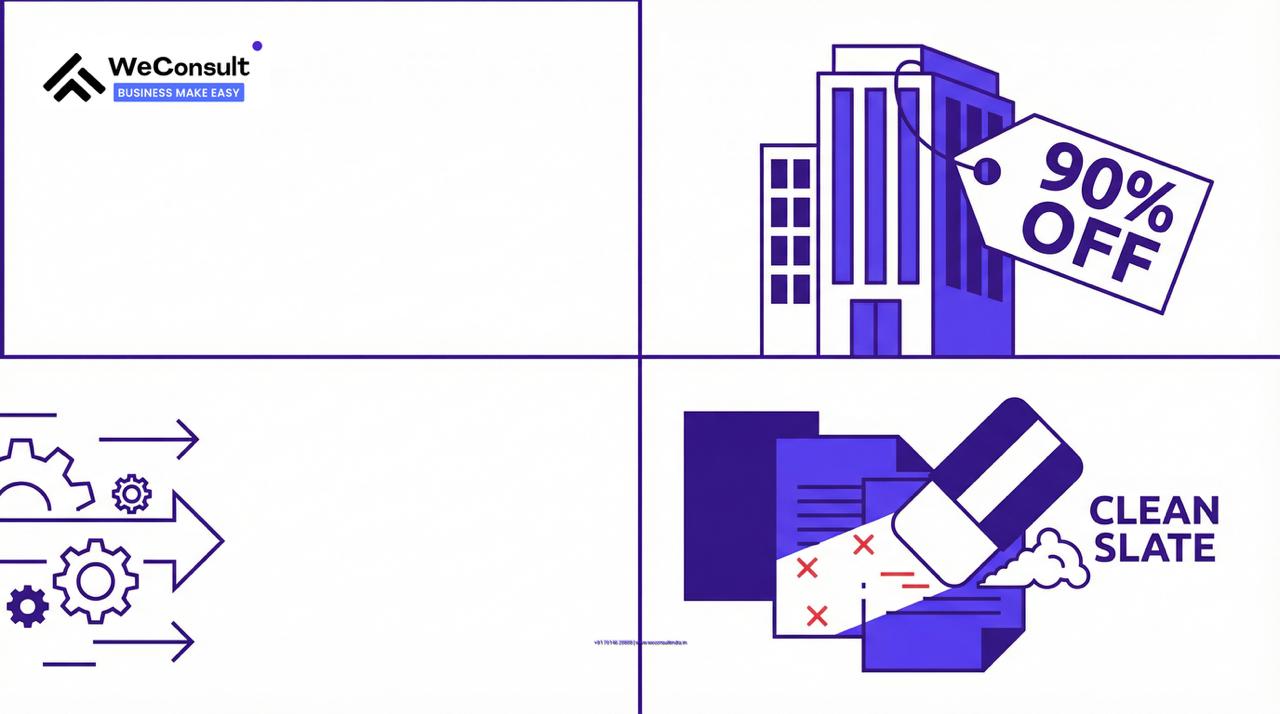
Compliance Bulletin 2026 1. The Compliance Crisis: Why CCFS-2026 Matters Now Expert Analysis by The WeConsult India Desk For many Indian business owners, the "ROC filing" is that one task that keeps getting pushed to the next quarter. But as the quarters turn into years, the additional fees don't just add up—they multiply. By 2026, thousands of active and dormant companies found themselves in a compliance deadlock, unable to file current documents because of the massive backlog of penalties from previous years. The Ministry of Corporate Affairs (MCA) has recognized this bottleneck. On February 25, 2026, the MCA issued General Circular No. 01/2026, announcing the Companies Compliance Facilitation Scheme (CCFS) 2026 . This isn't just another extension; it is a strategic "clean slate" initiative designed to bring every Indian company back into the fold of active compliance before the full implementation of the new digital monitoring systems later this year. 2. What Exactly is CCFS-2026? The CCFS-2026 is a one-time amnesty scheme that allows defaulting companies to file their overdue documents by paying only a fraction of the usual additional fees. Specifically, the scheme offers a 90% waiver on the additional fees that would otherwise be payable under Section 403 of the Companies Act, 2013. Starting from April 15, 2026, and running until July 15, 2026 , companies have a 90-day window to regularize their status. This scheme covers almost all annual filings, including financial statements (AOC-4) and annual returns (MGT-7), which are the most common sources of non-compliance. By providing this window, the government is essentially saying: "We want you compliant, not bankrupt." 3. The "90% Waiver" Math: A Real-World Example Imagine a company, "Alpha Tech Pvt Ltd," which has failed to file its annual returns for the last three financial years. Under normal circumstances, the penalties could easily exceed ₹2,00,000 . Standard Penalties ₹2,00,000+ → Under CCFS-2026 ₹20,000 This massive reduction makes it financially viable for small and medium enterprises (SMEs) to clear their records without draining working capital. 4. Who Can Benefit? It applies to any "defaulting company"—active or dormant. However, companies already struck off by ROC or involved in serious fraud litigation are excluded. The goal is to help genuine businesses fall back into compliance. 5. The Immunity Clause Under this scheme, once overdue documents are filed and reduced fees paid, the MCA will grant Immunity from Prosecution or proceedings for penalties related to those specific delays. 6. The Step-by-Step Filing Process 1 Identify all pending forms and calculate normal fees. 2 File forms through MCA21 V3 portal (April 15 – July 15). 3 Apply for the Immunity Certificate as the final step. Note: The immunity isn't automatic; you must explicitly request the certificate. 7. Why You Shouldn't Wait Until July Historically, during the closing days, the MCA portal experiences massive traffic surges, leading to glitches. Starting now ensures you are first in line when the window opens on April 15. 8. The Cost of Ignoring This Opportunity Once CCFS-2026 concludes, the 90% waiver disappears. Reverting to full penalties and potential mass disqualification of directors makes "Struck Off" status a real nightmare. 9. Impact on Dormant and Inactive Companies For companies wishing to restart or even close legally, this is the perfect bridge to clear records cost-effectively without leaving a trail of legal liabilities. 10. The Role of Digital Compliance in 2026 The launch of CCFS-2026 is part of a shift toward Real-Time Compliance. With better data analytics, the government can now automatically flag inconsistencies without manual intervention. 11. Smart Money Moves for Directors 1. Audit Your Dashboard: Log into the MCA portal or consult your CS to get a definitive list of pending forms. 2. Allocate the 10%: Set aside the funds for the reduced fees now for the April 15 opening. 3. Update Your KYC: Ensure all directors' DINs are active and KYC is updated (DIR-3 KYC). 12. Frequently Asked Questions (FAQs) Q: Does CCFS-2026 apply to LLPs? A: Check for the "LLP Settlement Scheme 2026" updates, usually announced simultaneously. Q: Can I file for FY 2025-26 under this scheme? A: No. The scheme is for overdue filings from previous years. Q: What if my company is already in litigation? A: You can still file, but may need to withdraw pending appeals related to additional fees. 13. The Big Picture: India's Corporate Governance Shift The government is moving toward a "facilitation" model. Once the "clean slate" is provided, the tolerance for future non-compliance will be zero. Align your business with the "New India" standards now. 14. Bottom Line The MCA CCFS-2026 is a rare second chance in the world of corporate law. With a 90% waiver on fees and full immunity from prosecution, there is no logical reason to remain non-compliant. Stay compliant. Stay ahead. — The WeConsult India Desk